
Digital Asset Trends 2026: From Cycles to Structure

Updated: Jan 1

2025 has been a reminder that familiar crypto narratives do not always age well. Expectations built around halving cycles, clean post-event rallies, and simple beta exposure were repeatedly challenged as price behaviour diverged from prior playbooks. In their place, a more complex picture has emerged, shaped by liquidity conditions, institutional positioning, and the growing interaction between digital assets and the broader financial system.
Looking ahead to 2026, the most important developments are unlikely to be defined by price targets or short-term forecasts. Instead, they'll centre on how capital is allocated, how infrastructure is used together with the parts of the digital asset ecosystem demonstrate economic relevance.
Here we look at some of the biggest trends that will continue to build out the digital assets space in 2026 and beyond. These trends are not predictions, but themes that are shaping how investors, institutions, and policymakers engage with the space.
1. Bitcoin as Balance-Sheet Primitive and Portfolio Bedrock
Bitcoin’s role within portfolios has continued to evolve beyond simple price exposure. While ETFs provided an important access point, the more consequential shift has been the gradual framing of Bitcoin as a balance-sheet asset. Corporate treasuries, funds, and even public institutions are increasingly discussing Bitcoin in the same structural context as other reserve-like assets.
Figure 1: Bitcoin ownership continues to migrate toward institutional and balance-sheet holders, with ETFs, public companies, and other funds accounting for a growing share of supply.

This marks a move away from viewing Bitcoin as a standalone trade and toward treating it as the foundation of broader digital-asset strategies. For asset managers, this has coincided with a “beyond Bitcoin” perspective, where Bitcoin serves as the anchor around which exposure to other digital assets is constructed and risk is bench-marked.
The implication for 2026 is not necessarily broader retail participation, but deeper institutional integration. As Bitcoin becomes embedded in portfolio construction frameworks, its influence extends beyond its own market and begins to shape how digital assets are evaluated more broadly.
2. Liquidity Regimes Overtake Cycle Heuristics
One of the clearest lessons from 2025 was that traditional cycle heuristics proved insufficient. Post-halving price behavior diverged from historical norms, prompting renewed debate around extended cycles, regime shifts, and so-called super-cycles. In practice, while liquidity remains a core driver, the relationship has become increasingly non-linear.
As evidenced by the rolling correlation between Bitcoin and global M2, a notable decoupling occurred in the summer of 2025. While global M2 continued its upward trajectory, Bitcoin’s performance showed greater sensitivity to specific funding market stresses and dollar dynamics than to broad liquidity expansion.
Figure 2: The divergence between Bitcoin and global M2 highlights a shift away from simple cycle heuristics, reinforcing the growing importance of liquidity regimes in shaping returns

As crypto becomes more intertwined with macro portfolios, the challenge for 2026 will be identifying the specific liquidity regimes and capital flow bottlenecks that dictate performance, ergo not simply tracking M2. This shift will of course have important implications for strategy design, risk management, and expectations around volatility.
3. Stablecoins as a Settlement Layer, Not a Crypto Product
Stablecoins have continued to expand quietly, largely outside the spotlight that follows price volatility. Their growth has been driven less by speculation and more by their utility as settlement instruments, particularly in payments, remittances, and cross-border transactions.
Regulatory progress in 2025 has already shifted the focus away from whether stablecoins should exist to how they are integrated. Legal frameworks are now increasingly addressing operational questions, while institutions explore how stablecoins can complement existing payment rails rather than replace them outright.
This shift is effectively reframing stablecoins as financial infrastructure rather than crypto products. As settlement layers, they are becoming one of the most tangible points of contact between digital assets and the real economy.
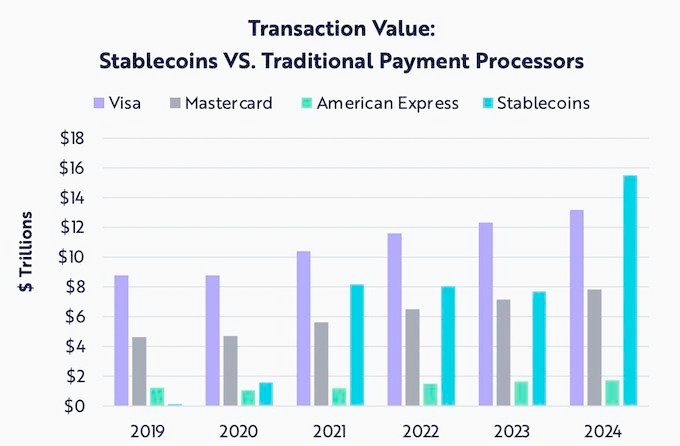
Figure 3: By 2024, stablecoin transaction volumes had reached levels comparable to major payment networks for the first time, marking an important inflection in their role as a settlement layer.
4. Tokenisation Moves Beyond Pilots Toward Market Structure
Tokenisation has spent much of the past few years in pilot mode, with numerous proofs of concept but limited scale. That dynamic is beginning to change as attention turns toward distribution, liquidity, and settlement efficiency rather than technical feasibility.
In 2026, the more meaningful question will be centred on which assets are most suited to tokenisation from a business model perspective and how it meaningfully improves market structure. The prospect of near-continuous trading, faster settlement, and programmable ownership has implications for everything from fund distribution to collateral management.
Figure 4: Tokenised real-world assets continued to scale through 2025, with Treasuries and private credit leading on-chain adoption.

As tokenised assets grow in scale, the lines between TradFi and on-chain finance will become increasingly blurred. But ultimatley what matters is not the label, but the efficiency gains that the infrastructure enables.
5. Privacy Re-Emerges as a First-Order Monetary Question
Interest in privacy has resurfaced as a practical concern rather than an ideological one. As surveillance, compliance, and reporting requirements expand, the utility of privacy-enhancing technologies is increasingly viewed through the lens of everyday monetary use.
As evidenced Zcash's recent breakout performance, renewed attention to privacy-focused assets reflects broader questions about crypto’s role as a medium of exchange.
Figure 5: Renewed outperformance in privacy-focused assets highlights a return of interest in transactional confidentiality as a functional requirement.

For Bitcoin and the wider ecosystem, this has implications for wallet design, payment flows, and the balance between transparency and usability. In 2026, privacy is likely to be discussed less as a niche feature and more as a functional requirement for money in motion, particularly in cross-border and high-frequency use cases.
6. Bitcoin Layer-2s: Optionality Over Immediate Adoption
There is no question that Bitcoin L2 development was a standout theme in 2025, yet as we head into 2026, the narrative has shifted from pure scalability to infrastructure readiness. While activity across some L2s has softened from earlier peaks, focusing solely on current usage risks overlooking their longer-term optionality. These layers are increasingly tied to the emergence of a Bitcoin-native economy, focusing on yield generation and trustless financial activity.
A major development in this space is the maturation of decentralised innovations like sBTC on the Stacks network, which allows for allows for a decentralised, trustless two-way peg unlike centrally-controlled legacy solutions like wrapped Bitcoin (wBTC).
As shown in the chart below, the amount of native Bitcoin (BTC) being "pegged into" the Stacks network has surged. This rise in sBTC supply suggests that while headline transaction volumes may appear low, sophisticated holders are actively activating "lazy" Bitcoin for productive use.
Figure 6: The rise in sBTC supply suggests that while headline Layer-2 activity remains modest, sophisticated holders are increasingly activating previously idle Bitcoin for productive use.

Ultimately, it is the unrivaled security and trust of the network that makes Bitcoin finality so coveted. For 2026, the more important indicators remain developer activity and the successful removal of sBTC supply caps, which have already begun to attract institutional-grade capital. If demand for Bitcoin-secured financial activity re-accelerates, adoption is primed to move quickly from this high-integrity base.
7. Fundamental Discrimination Returns as Easy Liquidity Fades
Extended periods of easy liquidity tend to blur important distinctions. Strong and weak projects can trade in the same direction for long stretches, and price action alone does a poor job of reflecting underlying quality. That dynamic has been familiar across digital assets over the past few years.
More recently, those differences have started to reappear but performance has become more uneven, with attention shifting toward fundamentals that are harder to ignore such as where revenues are coming from, whether fee generation is repeatable, and whether usage reflects something more durable than short-term narrative.
As 2026 approaches, this shift is likely to shape how capital is deployed. Broad exposure becomes less effective, while selectivity matters more. For institutionals in particular,m the emphasis moves away from capturing beta and toward identifying where economic activity is real and sustainable.
Honourable Mention: AI and Crypto Begin to Reshape Digital Commerce
The overlap between AI and crypto remains early, but its relevance is becoming easier to define. As software systems take on a greater role in initiating and executing transactions, the importance of native digital settlement, programmable payments, and machine-to-machine interaction increases.
In this context, crypto’s role is primarily infrastructural. Stablecoins, tokenised assets, and on-chain settlement offer a framework that aligns with automated commerce without relying on intermediated payment rails. While most applications remain at an early stage, the interaction between AI-driven systems and digital asset infrastructure is likely to become more visible into 2026, shaped by utility rather than much of the narrative driven hype of 2025.
Conclusion: Interpreting the Signals That Matter
The themes shaping 2026 are less about discovering new narratives and more about identifying which developments have staying power. Liquidity conditions, infrastructure adoption, and institutional integration now play a larger role in determining outcomes than simple cycle-based expectations.
Taken together, these trends provide a framework for interpreting how the digital asset space continues to mature. They are not exhaustive, nor are they immune to change, but they offer a more grounded lens through which to assess where the market is heading.
For more information about our custom research services please get in touch directly, contact us here. Download our latest featured report below.
Disclaimer: The information contained within is for educational and informational purposes ONLY. Any commentary provided is the opinion of the author and should not be considered a personalised recommendation. The information contained within should not be a person's sole basis for making an investment decision. Please contact your financial professional before making an investment decision. No commercial relationships or partnerships exist with any of the technology providers, manufacturers, or suppliers herein.


Comments